
Lovense, the global leader in app-controlled intimate products, today released findings from a proprietary survey examining the real barriers to prostate pleasure adoption among men. The quantitative findings were validated against a qualitative analysis of over 10,000 posts and comments across major men’s wellness communities online. The results challenge the industry’s long-held assumption that pain and hygiene concerns are the primary purchase blockers — and point to a different, more addressable obstacle.
Key Finding #1: Partner Judgment Is the Single Biggest Barrier
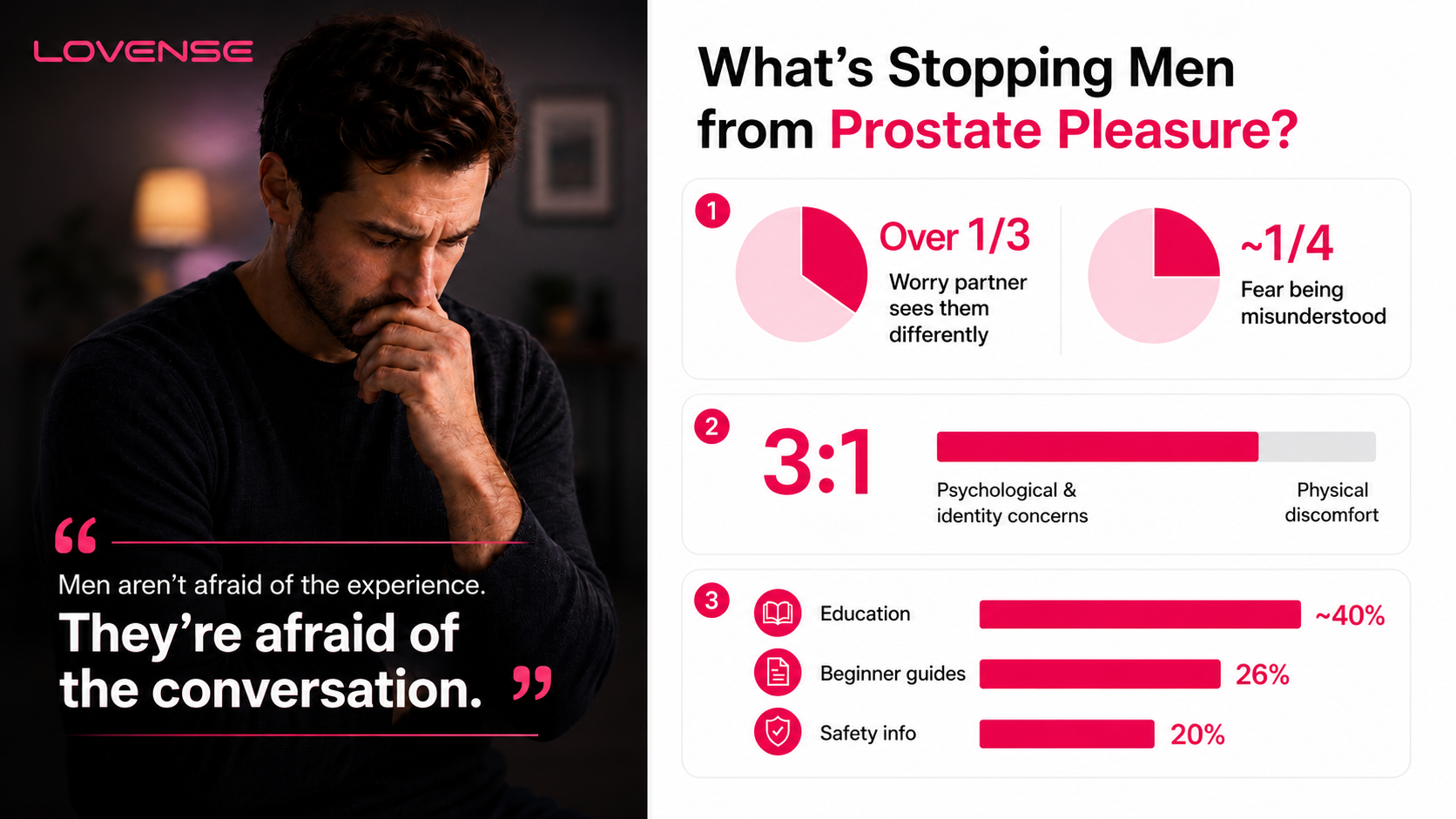
Nearly one in five respondents (18.3%) cited “not knowing how to talk about it with a partner” as their single biggest barrier — the highest single response, ahead of both hygiene concerns and fear of pain.
The pattern holds across multiple questions: over a third of respondents worry their female partner may see them differently, and roughly one in four report fear of being misunderstood. In online communities, this fear is the single most emotionally charged topic. One wife who discovered her husband had hidden his prostate play for 18 years wrote: “I was absolutely crushed. Not because of what he was doing, but because he left me in the dark for nearly two decades.” Men aren’t afraid of the experience. They’re afraid of the conversation.
Key Finding #2: Psychological Barriers Outweigh Physical Ones
Identity and social concerns surpass physical discomfort as blockers at roughly three-to-one ratio. Fear of being perceived as gay or bisexual, concern that it conflicts with straight male identity, and worry about feeling “less masculine” collectively dwarf fear of pain — which ranked as the single biggest barrier for fewer than one in ten respondents. The community’s most upvoted response to this anxiety captures the shift underway: “You’re a damn grown man! Own it!” The industry’s messaging around “comfort” and “painless design” may be solving the wrong problem.
Key Finding #3: A Clear Education Gap Persists
When asked what would increase their confidence, almost 40% respondents chose education: beginner-friendly guides, clear safety information, and more mainstream discussion to normalize the topic — all ranked above product features or pricing. The preferred framing? “Prostate orgasm” led decisively — men respond to direct, pleasure-focused language rather than clinical or euphemistic alternatives. As one highly upvoted community comment put it: “I had no idea the prostate could even bring pleasure.”
Lovense’s Response: Edge 2
Lovense has positioned its Edge 2 prostate massager as a direct response to these findings. The product features App-based partner control — allowing a partner to adjust vibration patterns remotely — designed specifically to transform prostate play from a solitary secret into a shared experience.
The approach is informed by community data showing that partner involvement is simultaneously the greatest accelerator and the greatest barrier. When partners engage positively, user satisfaction increases dramatically — the dataset’s single most-upvoted post (2,607 votes) described a session that was “interrupted” by a curious girlfriend, turning a private moment into a shared discovery.
“The data showed that the product isn’t the problem — it’s how people handle it with their partner,” said a Lovense spokesperson. “Edge 2’s partner control feature was built to make that first conversation easier by giving both people a role.”
Lovense conducted a proprietary survey on prostate pleasure attitudes and barriers, and validated findings against qualitative analysis of over 10,000 posts and comments across major men’s wellness communities on Reddit.