

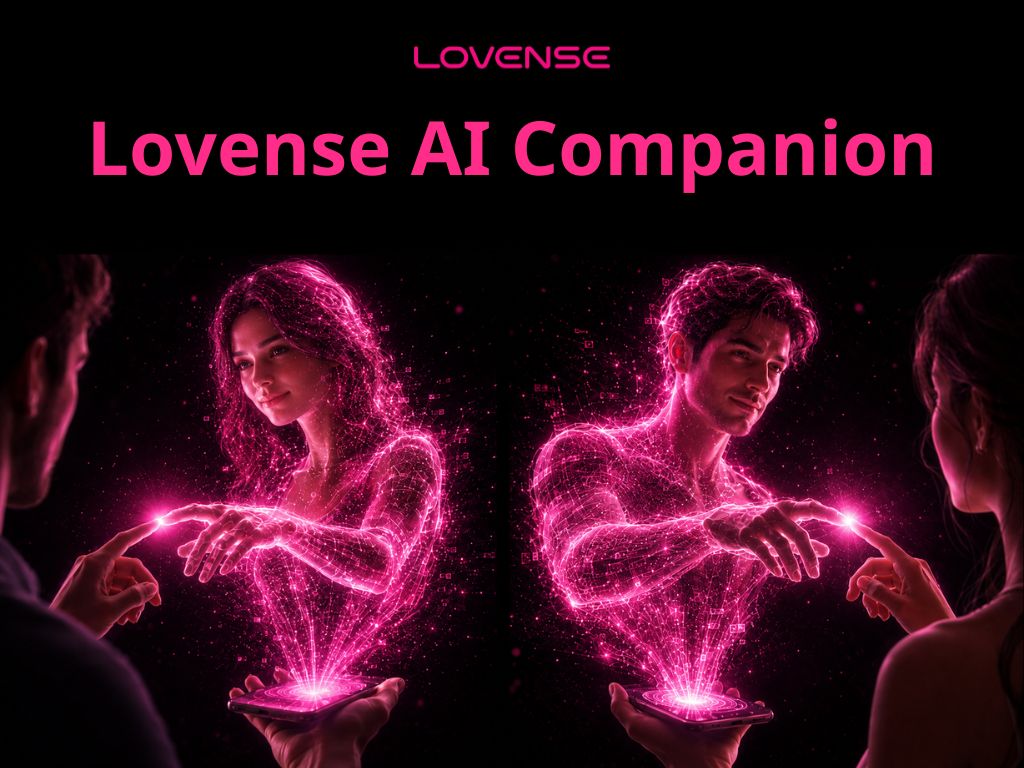
Most AI companion experiences remain confined to text and voice on a screen. The technology can be endlessly patient, available around the clock, and recall every detail of a conversation from months ago — but it cannot make any of that felt. The emotional intelligence is there; the physical layer is not. Until now.
The shift from screen to sensation arrives at a time when demand has never been higher. The AI companion market has experienced rapid expansion, with industry analysts projecting it will reach nearly $300 billion by 2034.
While numerous companies have entered the AI partnership and intimacy chatbot space, Lovense brings distinct advantages to the category. This year, Lovense AI Companion leverages the company’s connected ecosystem of smart devices, open API, and 200+ third-party integrations to deliver an experience that pure-software companions cannot replicate.
During the first week of the launch, the company reported a 24 percent increase in Daily Active Users, reflecting strong early demand for AI-driven intimate experiences.
Beyond the Screen
Lovense has spent years building what few in intimacy tech have attempted: a fully connected ecosystem spanning smart devices, a widely adopted app, third-party integrations, and an open developer platform — designed not as a walled garden, but as an open world. The Lovense AI Companion does what other AI companions can’t: it moves off the screen, enters the real world.
The Lovense AI Companion connects directly to the user’s toy, syncing the device to match the conversation in real time — the flat-screen experience starts to feel like shared presence. But the larger move is the open architecture: Lovense maintains the only brand-operated open API in sex tech, integrated with over 200 platforms, and in 2025 has been recognized as the first company in the intimacy industry to adopt the Model Context Protocol (MCP) — the emerging standard that allows external AI agents to access and interact with the Lovense ecosystem.
In practice, that means users of third-party AI platforms can connect their preferred AI experience to a Lovense device. With the user’s consent, the character on the screen gets a way into the room, the physical world.
Contextual Awareness Across the Ecosystem
The connection goes beyond the device itself. Inside the Lovense ecosystem, every interaction generates context, and the AI Companion can be present through all of it subject to user authorization.
For example, after a user spends an hour gaming via Lovense Remote’s Game Sync mode, the AI Companion may later reference the session: “You were incredible in that last round — teach me how you did it.” After a film watched through Video Sync, it might say: “I loved that movie. Let’s watch another one together soon.” The AI Companion does not simply respond when prompted — it maintains continuity across activities, turning everyday moments into shared experiences.
The goal is to add a physical dimension to AI-driven interactive experiences — bridging digital interaction with real-world sensory feedback.
Responsible Innovation
As AI companions grow more capable and physical, questions of trust, consent, and data privacy become central to the category’s development.
“AI companionship has moved beyond the screen. That shift changes the equation entirely,” said Dan Liu, CEO of Lovense. “The more intimate and personal the technology becomes, the higher the standard for consent, data privacy, and trust must be. We see this not as a constraint but as the foundation the entire category needs in order to scale. Innovation that ignores those boundaries won’t last.”
About Lovense
Lovense is a connected intimacy technology brand building products and experiences that help people feel closer across distance and in real time. Through interconnected devices, a widely adopted app ecosystem, and integrations across creator and cam platforms, Lovense has built one of the industry’s most comprehensive interactive intimacy ecosystems.