

Lovense has released the Lovense Distance Index 2026. It is the world’s first white paper on remote intimacy. It covers 5.036 million anonymized sessions that couples ran on the Lovense Remote app between October 2025 and September 2026. The average date ran 20.4 minutes, and together they add up to more than 100 million minutes of play. Long-distance intimacy has rarely been studied at this scale. The Distance Index shows the hours couples choose and the borders they cross.
Valentine’s Day, and the Day After
Couples went on about 22,000 remote dates on February 14, 49% more than on comparable weekdays. But the median date that night lasted 6.6 minutes, shorter than on an ordinary day. On February 15 it rose to 11.7 minutes, 77.6% longer than on Valentine’s Day itself. So couples kept the holiday going for a second night.
Remote Play is a Weeknight Habit
Couples connected most between 10 and 11 p.m. local time. On 37.8% of the days a partner connected, they came back for a second round. Those numbers describe a nightly habit. Couples have built it into the end of an ordinary day.
Where the routes run
Eleven of the 20 busiest routes in the report link two countries. Couples split between Canada and the US had about 26,000 remote dates. UK–US couples had about 22,500, and Australia–US couples about 11,800. The report also details Nigeria–US and Netherlands–US routes. Inside the United States, couples met up about 199,000 times.
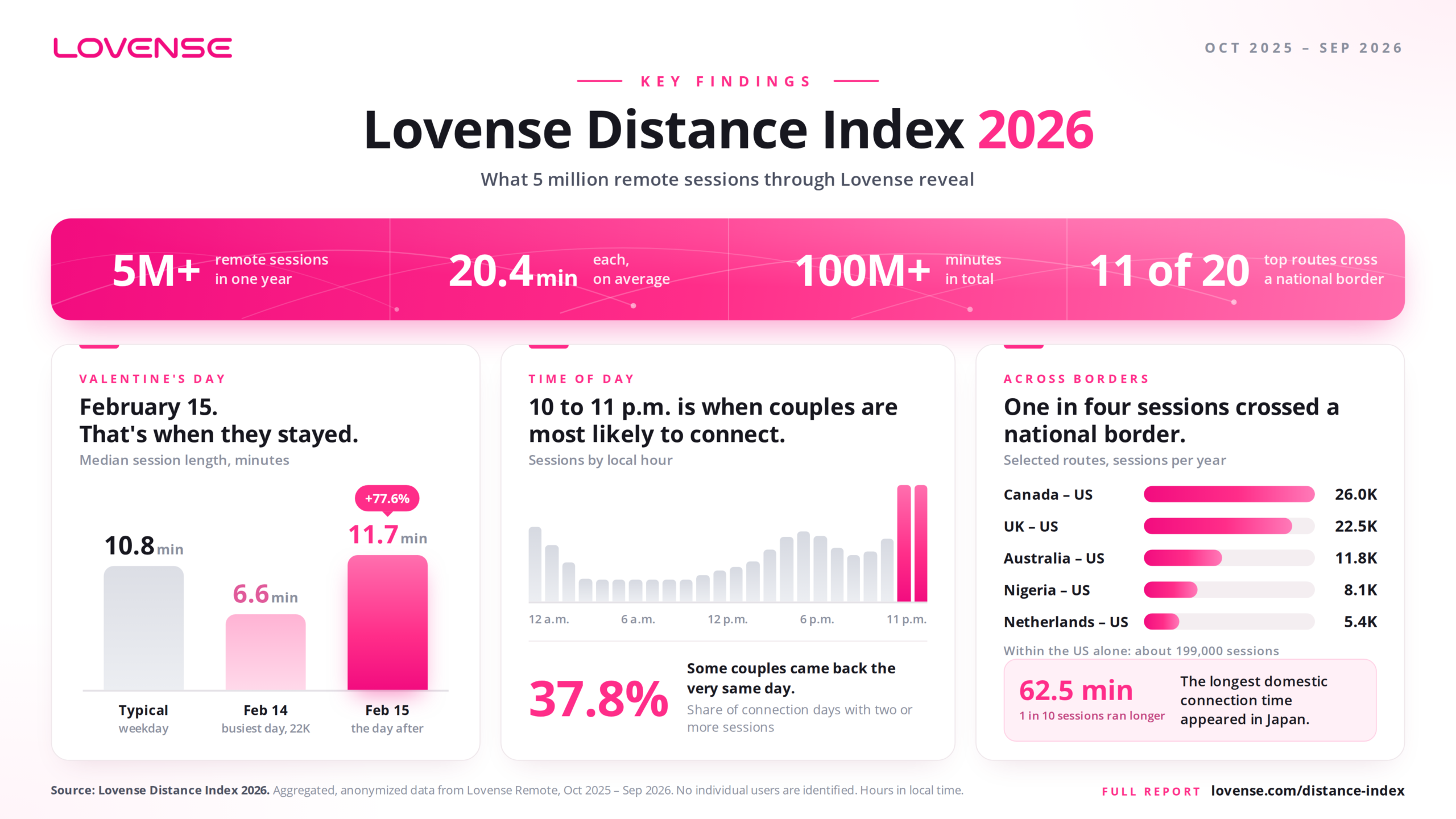
On every cross-border route, one partner lives outside the US. Those couples need no extra hardware to cross the distance. When one partner taps the screen in the app, the command travels over the internet to the other partner’s phone. That phone passes it to the toy over Bluetooth. Among routes inside a single country, couples in Japan stayed connected longest, and one rendezvous in ten there ran past 62 minutes.
No government counts long-distance couples, so the size of this market has gone largely unmeasured. The United Nations counted 304 million international migrants in 2024, nearly twice the 1990 figure. In the US, 12.5% of couples who married in 2023 were living apart from their spouse, according to researchers at Bowling Green State University. The Distance Index shows how big that demand already is. It counts more than 5 million connections in a single year, on a single app.
“We found a lot of interesting details in this report,” said Dan Liu, founder and CEO of Lovense. “We also saw how many couples really do use our products to stay close. That makes our work mean more to us. We believe this report shows only part of the demand for long-distance intimacy. Technology can give love a touch that reaches across mountains and oceans.”
Lovense put its first app-controlled toys on sale in 2013. Every one of these dates ran on Lovense Remote, the hub of the Lovense ecosystem. The same connection lets couples sync toys to music, video, live streams and games built with Lovense’s Unity and Unreal plugins. Outside developers build their own apps on its public APIs. The person wearing the toy decides how long the play lasts and can stop it at any moment.
The full report is free to read at lovense.com/distance-index. Business and media inquiries: partners@mail.lovense.com.
About the data
The Lovense Distance Index 2026 analyzes 5.036 million valid remote sessions on Lovense Remote from October 2025 to September 2026. Times use the local time of the session-end event on the reporting side. All data was aggregated and anonymized. The report does not identify individual users.